I came to Southeast Asia this past fall. In my introduction to the country, I had difficulty finding people I could really connect with or who understood my American slang. Although I was grateful for people’s English-speaking abilities, I secretly hoped to have someone who just got my fast-paced, slang-heavy way of talking. God faithfully answered this prayer through my office mate, where I help with the communication side three times a week. The Lord has used Asma since the very beginning of my time in Southeast Asia. She was one of the first people I truly felt comfortable around. Asma and I bonded over shared English phrases, TV shows, and history. One of the first moments I knew God had put us in the same office—at the same desk—was when we discovered we had both struggled with eating disorders in the past. From there, our friendship grew quickly. We often get distracted talking about her recent cosplaying or the show we are watching. She has also opened up about the struggles of being a refugee from Myanmar—the hardship her family has faced and the ongoing frustration of living as a refugee in Southeast Asia. That reality leaves her more vulnerable and with less protection. Yet even in the middle of all of that, Asma is easygoing, engaging, bright, and incredibly creative.
As time has gone on, we’ve had more opportunities to talk about our respective faiths—hers being Islam and mine being Christianity. We’ve especially talked about similarities, like Lent and Eid al-Fitr, and the importance of God in our lives. Weeks later, my director prompted me to think about doing a shared prophet study with her. The idea is to look at both the Qur’an and the Bible together—to see, seek, and reflect on the shared prophets between the two. I was initially hesitant to ask her because I didn’t want her to think I had only been her friend to convert her. She works at the same NGO and knows our mission. She’s also had uncomfortable moments in the past when Christians have tried to convert her. I hoped she would see my question and desire as an honest curiosity about Islam. But to my delight, she agreed enthusiastically. We began with Adam the following week. So far, we’ve gone through Adam, Noah, and Moses. I could say many things about these meetings—especially my surprise at how similar the passages are—but also how kind and merciful God is portrayed in the Qur’an.
I try to approach our time with honesty. If something in the Bible feels confusing or even uncomfortable, I say that. But it does take faith and patience to let the Word speak for itself without immediately trying to defend it—to allow our natural reactions to the story to come up honestly. One moment that really stands out happened in our second week. We started by recapping the story of Adam and Eve. Asma shared that she was really shocked by Adam’s response to God in the Bible after eating the fruit.
In the Qur’an, when God asks Adam why he disobeyed, Adam immediately repents and asks for mercy. His humility and sorrow over sin are clear. But in the Bible, Adam’s response feels very different. He doesn’t repent—instead, he talks back to God and shifts the blame: “the woman You put here with me…” There’s no ownership, just deflection. For Asma, this response was unfathomable. To talk back to God—the Most High, the Holy One—felt completely incomprehensible. When she told me this, I realized… she’s right. Adam had some nerve. And we ended that conversation reflecting on the holiness of God. But I also saw another perspective that I didn’t share in that moment.
Yes, Adam’s response is wrong—but I also see something deeper in it. First, there is a kind of familiarity and closeness with God. Adam speaks to Him almost like a child might speak to a parent—the kind of relationship where someone feels safe enough to be fully themselves, even at their worst. Second, I see myself in Adam. Rarely is my first reaction to sin immediate repentance. More often, I shift blame or make excuses. Adam feels incredibly human in that moment—raw and real. And yet, this is the same humanity that God pursues. Just a few chapters later, God promises a new covenant, fully knowing how broken we are. He still makes a way to be with us.
That way is Jesus. This is my prayer—and my hope for you as well—that as Asma and I read, question, and explore together, she would begin to see Jesus through both the Bible and the Qur’an—that her curiosity would grow, and that one day she would know Jesus as her Savior, Father, and friend—her everything.
RoleCall exists to identify, equip, support, and mobilize the next generation for effective, creative, and sustainable engagement among the unreached and marginalized. We have an opportunity, as global mission senders, to pivot and meet the needs of equipping them. Our Cross-cultural Apprenticeship, Advance Team, and Pilgrimage give the next generation hands-on experience, discipleship, challenging study, and a place to innovate, all while receiving support and mentoring as they explore serving cross-culturally.
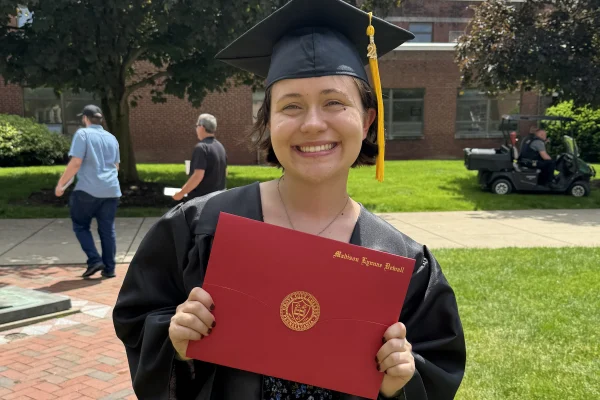
In high school, Maddie met weekly with a mentor who showed her the love of Christ simply by listening. Through their time together and reading the Bible, she came to understand that this love stemmed from Christ’s love for both of them. From then on, Maddie felt called to share that same love with others. Mission trips to rural Pennsylvania opened her eyes to the diversity within the body of Christ. The contrast between rural churches and the larger ones she was used to both challenged and inspired her. She began to long for a fuller picture of how the Spirit moves across different cultures and communities. She learned about RoleCall through connections at Redeemer Church in Greensboro. After talking with other sending organizations, a conversation with the director of RoleCall confirmed her direction. The director’s deep passion for missions and honoring different cultures made it clear that this is where she wanted to grow and learn next.