Article originally published in the Jubilate Deo: https://adosc.org/wp-content/uploads/2025/10/2025_fall_jubilate_deo.pdf
Daniel Booman, age 11, gave the following sermon on Saturday, September 20, 2025, to a gathering of 1,500 worshippers during the closing service of Holy Eucharist at the New Wineskins for Global Missions Conference, held at the Ridgecrest Conference Center in Black Mountain, NC. He spoke just prior to the Archbishop.
“We can show the world what it is like to be loved like a child of God,” said Booman, age 11, during his sermon. “We can bring hope to the nations.”
Hello, my name is Daniel Booman, and I’m from the Church of the Holy Comforter in Sumter, South Carolina. My dad is a pastor. My mom homeschools my siblings and me, and I have two brothers, Micah and Ezra, and one sister, Eva. I have two chubby orange cats who look like basketballs, and one skinny gray cat who looks more like a weasel, and also a hedgehog who hisses like a cat. So, we really like cats who look like other things and hedgehogs who act like cats.
I got to talk to the kids’ group at the last New Wineskins, and Mrs. Jenny Noyes asked if I would come share about our theme verse for this conference, Matthew 12:21: “In his name, the nations will put their hope.”
The first thing I noticed when I read this verse in my Bible was the footnote connecting these verses to Isaiah, who wrote them first. In Isaiah, I saw some differences that I thought were interesting. One difference, most obviously, is that the last line that Matthew writes in verse 21, “In his name, the nations will put their hope,” is not even in the Isaiah passage. Why did Matthew write that verse?
Matthew might have put that verse in because the Gentiles would probably have felt excluded from hoping in Jesus, because before that time, only the Jews were promised a savior they could hope in. Matthew wanted everybody to know that anybody can now hope for a savior, not just the Jews, because feeling excluded is a terrible feeling.
When I was about six years old, when we played outside after lunch at school, I always wanted to play with this kid named Tim, who was a lot older than me. He was so awesome. I often followed him around and asked him to play with me, but he always wanted to play with his friends who were his age. He was a nice kid, and he tried to include me sometimes, but I usually couldn’t keep up with him. I couldn’t make myself older than I was. And in the same way, before Jesus came, the Gentiles couldn’t be a part of the group. They couldn’t have a relationship with God, no matter what they did in their own strength. Imagine the Gentiles suddenly being welcomed into a family that they couldn’t get into by any powers of their own. It probably would have been difficult to grasp after so many years of being excluded. So now they have a savior to hope in.
The second difference I noticed was that in Matthew 12, verse 18, “he will proclaim justice to Gentiles.” Isaiah had originally used the phrase, “Bring justice.” But Matthew wrote “proclaim justice.” So what’s the difference between bringing justice and proclaiming justice? I think Matthew was saying that Jesus would take God’s justice on himself on the cross instead of the Gentiles receiving the justice they deserved, because the idea of bringing justice to the Gentiles might make them feel scared. Normally, we think of justice as punishment. But if Jesus took the punishment so that the people could proclaim that good news to the Gentiles, then they could have hope in Jesus instead of feeling scared of the punishment. It took away that fear.
The idea of being scared of punishment made me think about a time when I rode my little brother’s scooter down our steep driveway. My parents told me not to ride it down the driveway, but I did it anyway. So I lost control and landed right on my front teeth. I had just grown in my nice adult teeth, by the way. So anyway, I chipped my tooth. My mom was so upset. I was so exhausted from the fall that I took a nap. When I woke up, I found my dad sitting on the side of my bed. What was he going to say? Would I be grounded forever? I deserved punishment, but mom and dad paid for the dentist to fix it and forgave me. It was such relief to know that my parents loved me and wanted to make sure I was okay.
Maybe the Gentiles needed that assurance, too. Seeing all of these connections between the Gentiles of the Bible in my own life, I can see that we are all meant to feel cared for by God because he was willing to send his chosen beloved son to save us. He gives us what he most loved to rescue us from our own sin and include us in his family. If he loved his own son so much and was willing to give him up, he must love us immensely. God wants to save us. He wants us to have hope in him, and he wants to have a relationship with us.
Lots of people who have grown up in other religions or cultures think that they are slaves to their God and that their work depends on making the right sacrifices or doing enough good works. But that’s what makes Christianity different. With our God, we are not slaves. We are children, all of us. And so if we have a relationship with the one true God, it’s up to us to tell the others who don’t know what it’s like to be loved by God instead of being a slave. We don’t have to be slaves to our fear of judgment or losing our relationship with God because he is including us to be a part of his family forever.
Even if people have heard about Jesus, they might not understand what this new relationship with him looks like because they are still thinking of themselves as slaves. We can show the world what it is like to be loved like a child of God. We can bring hope to the nations.
Will you pray with me? Dear God, please give us strength to tell people about you and your never-ending love. Please let us show them what it means to be a child of God. In Jesus’ name we pray. Amen.
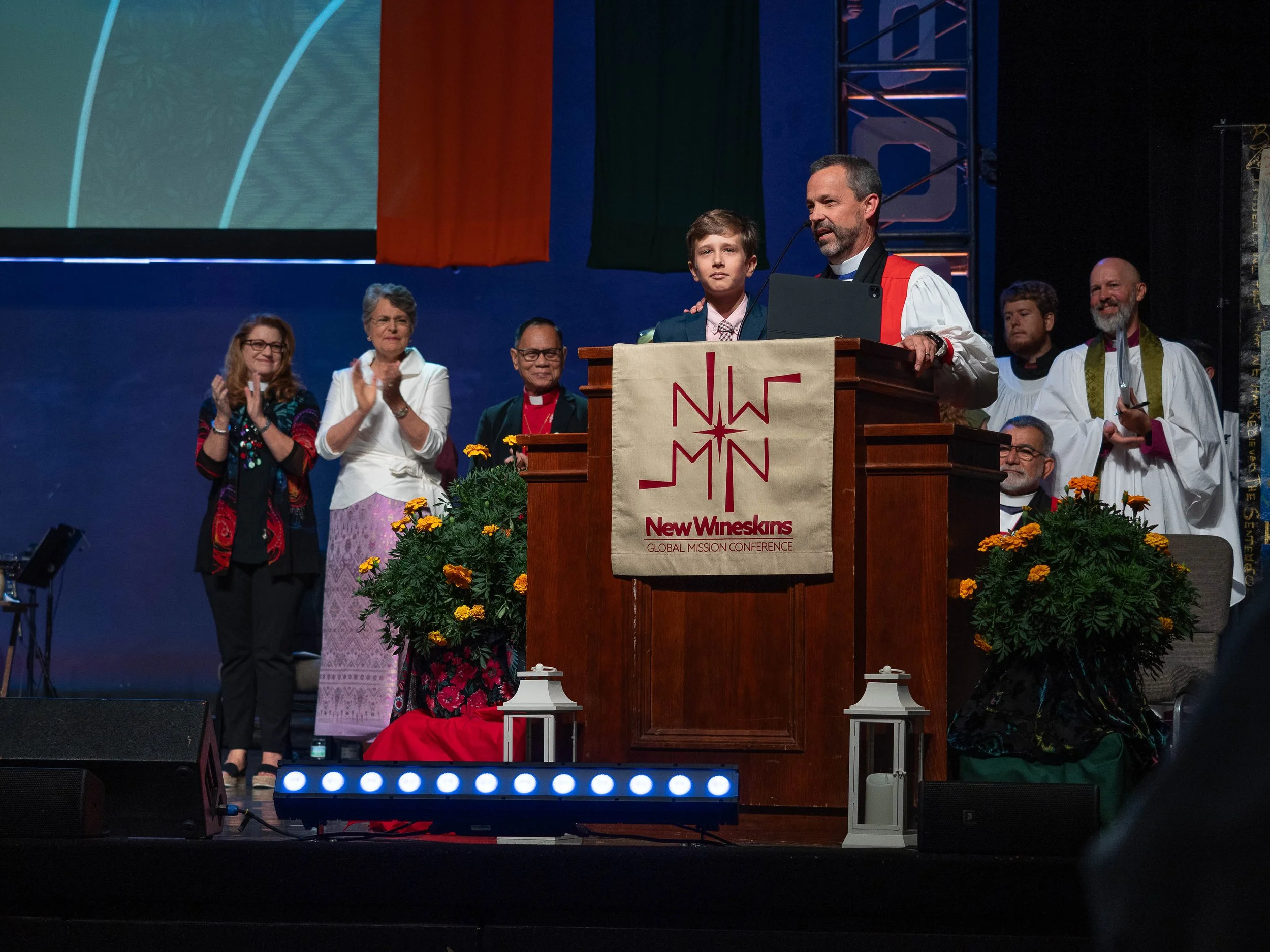
Following the standing ovation Daniel received, Archbishop Steve Wood joined him at the podium and, with his hand on Daniel’s shoulder, invited those gathered to extend their hands toward Daniel and pray for him. “Father, we thank you that before our eyes, the gospel transitions from one generation to the next. We thank you that in every generation you have raised up young men and young women to be your witnesses. We thank you today for Daniel. We thank you, Father, for your call upon his life. We pray that he would continue to grow in grace and favor and in knowledge and love of you and your son, Jesus Christ. We pray, Lord, that the work that you have begun in him would continue throughout the course of his life, that he might be your man in the appropriate time and season, and that he would be your witness in Jerusalem, Judea, Samaria, to the ends of the age and the world. In Christ’s name we pray. Amen. Well done!”

Daniel Booman lives in Sumter, SC and is 12 years old. He and his three siblings are homeschooled, and he especially loves playing piano. In his free time, he enjoys playing baseball, gardening, kayaking, reading, and hanging out with his cats.
Article originally published in the Jubilate Deo: https://adosc.org/wp-content/uploads/2025/10/2025_fall_jubilate_deo.pdf
View photos at https://adosc.pixieset.com/ newwineskins2025/ and the plenary speaker videos at https://www.youtube.com/@NewWineskins.